

Dollar stayed broadly firm after another major upside surprise in US inflation data reinforced expectations that the Federal Reserve will need to keep
Dollar stayed broadly firm after another major upside surprise in US inflation data reinforced expectations that the Federal Reserve will need to keep policy restrictive for longer. Sterling, meanwhile, remained under heavy pressure as Britain’s political crisis deepened further amid growing speculation that Prime Minister Keir Starmer could soon face a formal leadership challenge.
The latest US Producer Price Index report added to inflation concerns that had already intensified following Tuesday’s hotter-than-expected CPI release. The data reinforced concerns that elevated energy prices tied to the Middle East conflict are beginning to spread more deeply through the broader economy. PPI is widely viewed as a leading indicator for consumer inflation because higher production costs are eventually passed through to retail prices.
Fed rate expectations shifted further in response. Futures markets continued reducing expectations for policy easing this year, while implied odds of an additional Fed hike by year-end rose toward 40%. Some investors believe policymakers may eventually consider an “insurance” rate hike if inflation data over the coming months fails to reverse meaningfully.
Sterling, by contrast, came under renewed selling pressure as UK political instability intensified. Reports suggested Health Secretary Wes Streeting is preparing for his resignation and a possible formal leadership challenge against Prime Minister Keir Starmer as early as Thursday. According to reports, Streeting’s allies have already begun canvassing MPs in an effort to secure the 81 members needed to trigger a formal contest. The developments reinforced fears that Britain may be entering a prolonged period of political paralysis just as markets grow increasingly sensitive to rising gilt yields and fiscal risks.
Meanwhile, comments from ECB policymakers highlighted growing divisions inside the Governing Council over how to respond to the latest energy-driven inflation shock. Finland’s Olli Rehn warned of stagflation risks, arguing the ECB should avoid reacting mechanically to oil-driven inflation spikes while growth remains near stagnation. He stressed the importance of monitoring second-round effects such as wages and inflation expectations before committing to further tightening.
By contrast, Estonia’s Madis Muller adopted a significantly more hawkish tone, saying a June rate hike is “likely” unless there is a rapid resolution to Strait of Hormuz disruptions and a sharp decline in oil prices. French policymaker François Villeroy de Galhau struck the most cautious tone of the three, emphasizing that current inflation pressures remain largely energy-driven and warning against tightening prematurely before there is clearer evidence of persistent core inflation acceleration.
Overall for the week so far, Dollar is staying as the strongest performer but capped below last week’s high against all but Sterling. Aussie is the second best, and then Loonie. The Pound is currently the worst, followed by Swiss Franc, and then Yen. Euro and Kiwi are positioning in the middle.
In Europe, at the time of writing, FTSE is down -0.10%. DAX is up 0.35%. CAC is down -0.44%. UK 10-year yield is down -0.014 at 5.093. Germany 10-year yield is down -0.003 at 3.107. Earlier in Asia, Nikkei rose 0.84%. Hong Kong HSI rose 0.15%. China Shanghai SSE rose 0.67%. Singapore Strait Times rose 1.17%. Japan 10-year JGB yield rose 0.049 to 2.593.
Contents
- 0.1 US PPI Surges to Highest Since 2022 as Upstream Inflation Pressures Intensify
- 0.2 Eurozone GDP Expands Just 0.1% in Q1, Annual Growth Slows to 0.8%
- 0.3 Eurozone Industrial Production Misses Forecast as Energy Output Falls
- 0.4 OECD Sees BoJ Raising Rates to 2% by End-2027
- 0.5 New Zealand Inflation Expectations Jump as RBNZ OCR Outlook Turns Hawkish
- 1 GBP/USD Mid-Day Outlook
- 2 Economic Indicators Update
US PPI Surges to Highest Since 2022 as Upstream Inflation Pressures Intensify
US wholesale inflation delivered a major upside surprise in April as producer prices surged at the fastest monthly pace since 2022. Importantly, the pressure was not limited to energy alone, with both services and core producer prices accelerating sharply and reinforcing “higher for longer” Fed expectations. Read More.
Eurozone GDP Expands Just 0.1% in Q1, Annual Growth Slows to 0.8%
Eurozone growth lost momentum again in early 2026 as high energy prices and weak industrial activity continued weighing on the economy. Employment growth also softened, reinforcing concerns that Europe’s recovery remains fragile despite still-resilient labor markets. Read More.
Eurozone Industrial Production Misses Forecast as Energy Output Falls
Eurozone industrial production improved modestly in March, but the underlying details showed a highly uneven recovery. While capital goods and investment-related sectors strengthened, consumer goods output weakened sharply, highlighting persistent softness in household demand across Europe. Read More.
OECD Sees BoJ Raising Rates to 2% by End-2027
The OECD believes Japan’s monetary normalization cycle is still in its early stages, projecting the BOJ’s policy rate will rise from 0.75% to 2% by the end of 2027. Strong wage growth, resilient domestic demand, and improving inflation dynamics are increasingly supporting the case for continued tightening. Read More.
New Zealand Inflation Expectations Jump as RBNZ OCR Outlook Turns Hawkish
The RBNZ’s latest Survey of Expectations showed inflation concerns intensifying sharply in New Zealand, with one-year CPI expectations surging above 3.4% while markets also lifted their outlook for future OCR settings. At the same time, growth expectations weakened noticeably, highlighting a more difficult balancing act for policymakers. Read More.
GBP/USD Mid-Day Outlook
Daily Pivots: (S1) 1.3488; (P) 1.3548; (R1) 1.3597; More…
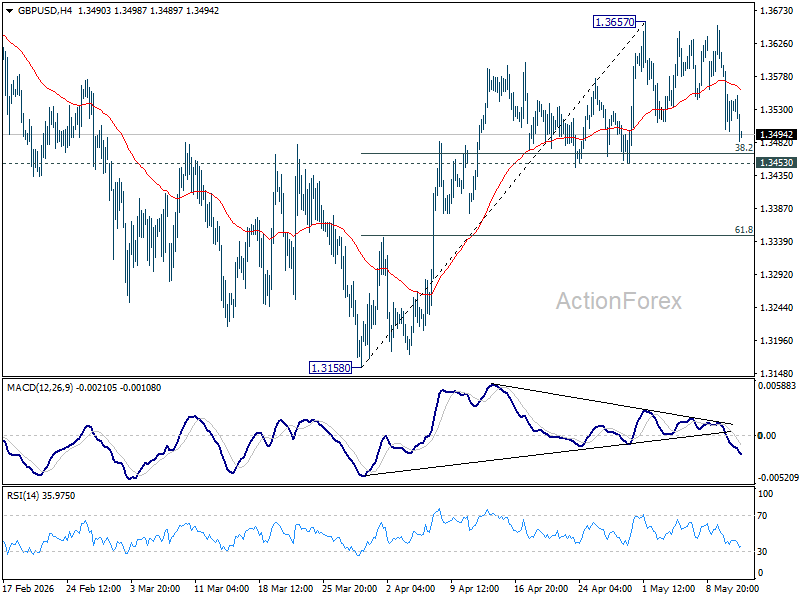
GBP/USD weakens again today but stays above 1.3453 support. Intraday bias remains neutral and further rally is still mildly in favor. On the upside, firm break of 1.3657 will resume the rally from 1.3158 to retest 1.3867 high. However, decisive break of 1.3453 will argue that the rebound has already completed, and turn bias to the downside for retesting 1.3158 instead.
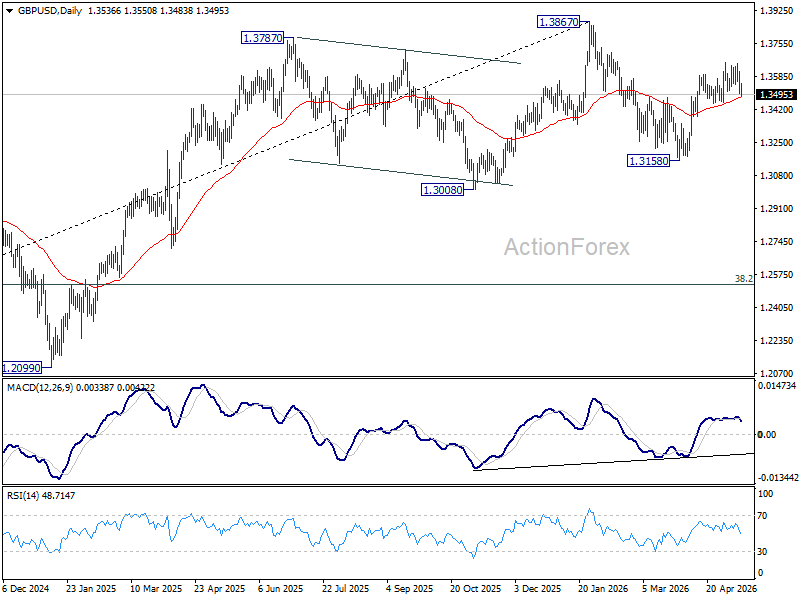
In the bigger picture, current development suggests that price actions from 1.3867 are merely a corrective pattern within the broader up trend from 1.0351 (2022 low). With 1.3008 support intact, medium term bullishness is maintained and break of 1.3867 is in favor for a later stage, towards 1.4248 key resistance (2021 high).
SOURCE LINK : Dollar Firm as Sticky Inflation Lifts Fed Expectations, Sterling Hit by UK Leadership Crisis