
















Momentum Hunter EA MT4
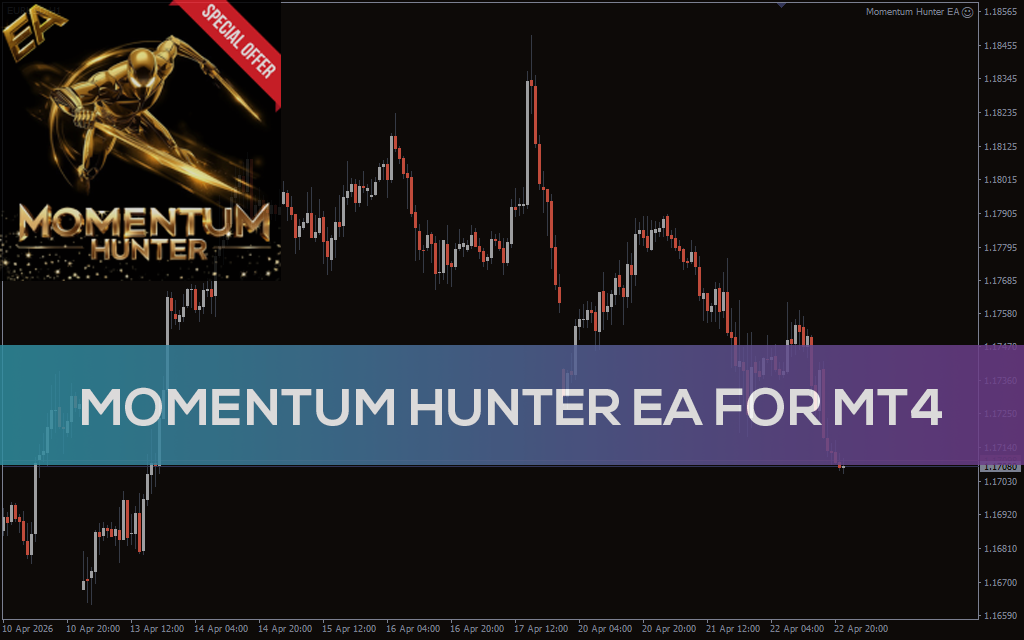
Momentum Hunter EA is an automated trading system designed to capture short-term market movements by following momentum shifts. Based on what I have seen during testing, this EA does not just sit idly by — it actively scans the market and opens positions frequently, trying to take advantage of both upward and downward price impulses.
I ran a full backtest to better understand how the system behaves in real conditions. With an initial deposit of $10,000, the EA managed to generate around $2,370 in net profit over 592 trades. On the surface, this shows stable growth, but once you dig deeper into the statistics, you start to see how the system actually achieves these results.


Momentum Hunter EA Recommended Settings
- Currency Pairs: EURUSD, GBPUSD, XAUUSD
- Timeframes: M15 – H1
- Minimum Deposit: $1,000+
- Leverage: 1:100 or higher
- Account Type: ECN / Raw Spread
Features of Momentum Hunter EA for MT4
Momentum Hunter EA has both momentum-based entries with a built-in recovery system. It is built for both directions (Buy & Sell) trade and supports hedging, as such it may have opposite positions where necessary.
Another thing to note is that it offers flexible trade management. The EA employs a lot multiplier of 1.5 and dynamic step logic, which makes it capable of scaling positions during drawdowns. It contains filters such as spread control, trade frequency limits, and optional drawdown protection, but these are by themselves not necessarily strict.
The model is obviously constructed to remain active in the market as opposed to attempting to be in perfect environments, which is why it has a relatively high number of trades and continuous engagement.
Strategy
Momentum Hunter EA is at the root of a momentum trading strategy backed by recovery techniques. The EA positions trades on the directional movement of the market to profit fast. This is shown in the average profit per trade that was about $12.77 versus the largest winning trade of $909.30.
But accurate entries do not necessarily mean that system works as intended. EA opens new positions using multiplier logic when trades enter drawdown. The strategy increases the likelihood of recouping the losses when the market retraces, but it also greatly expands exposure.
This is also the reason that, despite a strong profit factor of 1.84, the maximum drawdown of the system is very high at around $8,474 or 82.44%. So the profitability here is closely related to the way the EA copes with losing positions, and not just entry accuracy.
Trading Signals
In Momentum Hunter EA, trading signals are generated on a momentum basis and the main driver is momentum detection, so the EA reacts to price acceleration rather than waiting to confirm itself in the long run. It opens trades quite often and has a total of 592 trades during tests, 343 short and 249 long.
The overall win rate was about 68.5%, looking solid at first glance. The EA is capable of making sequences of profitable trades, with up to 11 straight wins seen in the test.
At the same time, losing trades are generally larger. The average loss was about -$15.12, in contrast to smaller but more frequent profits. This imbalance is representative of systems that use recovery mechanisms over strict stop-loss discipline.
Conclusion
Momentum Hunter EA is an aggressive and highly active trading system that focuses on capturing short-term momentum while using recovery logic to handle drawdowns. Based on my tests, it works well and can generate consistent profits, supported by a strong win rate and continuous market participation.
But the primary issue is clearly the level of risk. A drawdown exceeding 80% is extremely high — that means this EA is unsuitable for conservative trading or prop firm environments without serious adjustments.
I suspect Momentum Hunter EA can be interesting for experienced traders who understand how recovery systems function and are willing to manage risk manually. Without proper control, the same mechanism that generates profit can also lead to significant losses.
The post Momentum Hunter EA MT4 appeared first on indicatorspot.com.